

The Execution Gap: What Happens Between Strategy and Results? | Fourth Strategies
EXECUTION
Most organizations don't struggle to create plans. They struggle with what happens next
The execution gap is real.
The execution gap is the distance between what an organization intends to do and what it is actually capable of making happen.
The strategy is approved. The priorities are clear. The presentation is finished. Everyone leaves the room aligned. Then the organization returns to work. Existing responsibilities compete with new priorities. Decisions wait for approvals. Teams interpret the plan differently. Technology doesn't support the workflow. Months later, everyone is busy - but the outcome hasn't moved enough.
“The execution gap is the distance between what an
organization intends to do and what it is actually capable
of making happen.”
Alignment is not execution.
Agreement about what should happen doesn't create the conditions required to make it happen. Alignment creates direction. Execution creates movement. Confusing the two is one of the main reasons strategies stall.
Plans don't execute themselves.
A strategic plan describes what the organization intends to accomplish. Execution requires another layer of questions: Who owns the outcome? What capabilities are required? What processes need to change? What technology needs to support the work? What dependencies could prevent progress?
FROM INTENSION TO IMPACT
Business can hide the execution gap.
Teams can be extremely active without making meaningful progress. A useful question for leaders is: “What has become meaningfully different because of the work we've done?”
Execution problems are often upstream problems.
When something doesn't get done, it's tempting to blame accountability. But the real issue may be unclear strategy, weak systems, missing technology, or insufficient capacity. The visible problem and the underlying constraint aren't always the same.
Ownership matters. So does capacity.
Every initiative needs an owner, but ownership without authority, resources, or time creates frustration. Strong execution requires someone accountable and an environment that enables them to deliver.
Make the work visible.
Execution improves when teams can see what's being worked on, who owns it, what's next, and what's preventing progress. The goal isn't more reporting - it's faster, better decisions.
Execution is a system, not a final step.
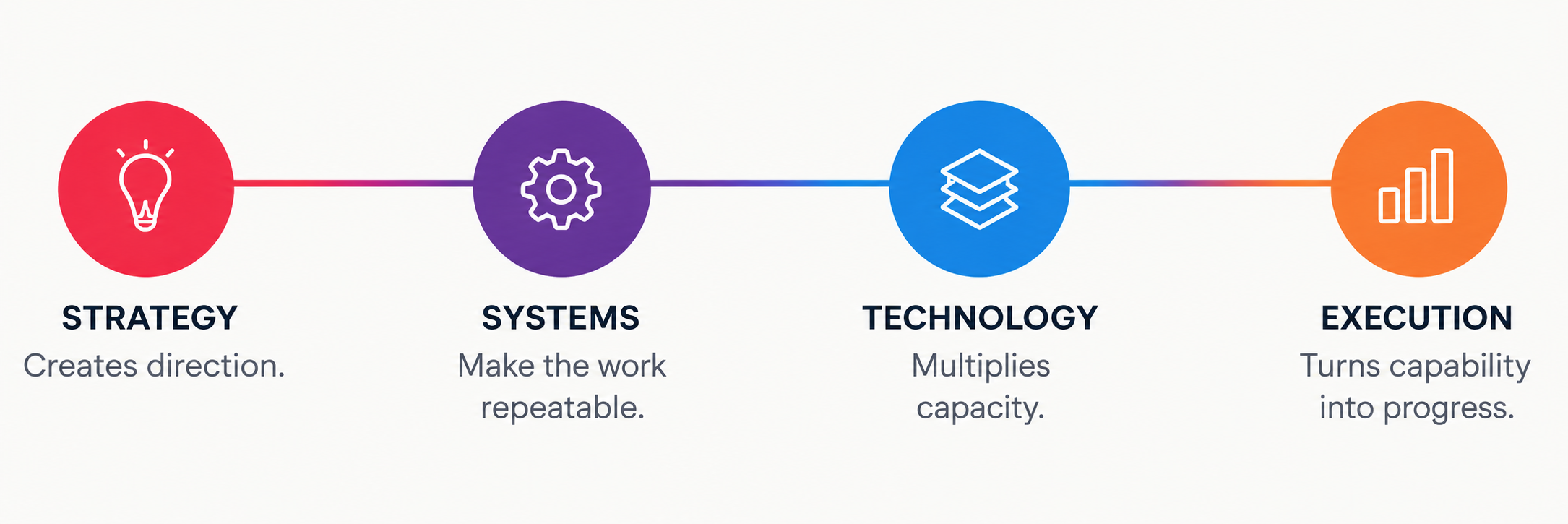
At Fourth Strategies, execution is one of four interconnected capabilities - Strategy, Systems, Technology, Execution - that work together to turn intention into outcomes.
Create shorter loops between decision and action.
The faster an organization can see, decide, act, and learn, the greater its ability to execute. Technology, clearer decision rights, and smaller experiments can all help.
Build execution into the strategy.
While developing strategy, ask: What new capabilities does this require? Who will own the outcomes? What must be true for this to work? These questions make ambition more executable.
The question after the strategy meeting.
Don't stop at “Next Steps.” Ask: What could prevent this organization from actually doing what we've just
decided to do? Find the constraints. Remove them. Build what's missing. Then keep moving.
TURN INTENSION INTO OUTCOMES
Fourth Strategies helps organizations close the execution gap by connecting strategic priorities with the systems, technology, operating capacity, and implementation support required to move the work forward.

Elevate
Engage
Empower
Powered by Gropl