
AI Expands Capacity. Strategy Determines Where. | Fourth Strategies
AI & OPERATIONS
Artificial intelligence is rapidly becoming more capable, more accessible, and easier to deploy. But the real question isn't “How do we use AI?” It's “Where does additional capacity create the most value?”
Start with the outcome, not the technology
Many organizations begin with the technology: What AI tools should we adopt? Where can we use AI? Which tasks should we automate?
These are reasonable questions. But they're not the first questions leaders should be asking. The better question is: where would greater capacity materially change what our organization can accomplish?
Once the desired outcome is clear, a more useful set of questions emerges: What's preventing us from achieving it today? Where is capacity constrained? Only then should we ask: Where can AI create meaningful leverage?
Don't automate a broken process.
AI doesn't eliminate the need for good systems. In many cases, implementing AI exposes weaknesses that were already there: unclear processes, fragmented data, inconsistent workflows, or knowledge that exists primarily inside people's heads.
Automating those conditions can simply create dysfunction at greater speed. Sometimes the right intervention is AI. Sometimes it's automation. Sometimes it's redesigning the workflow. The objective shouldn't be to use more AI. It should be to build a more capable organization.
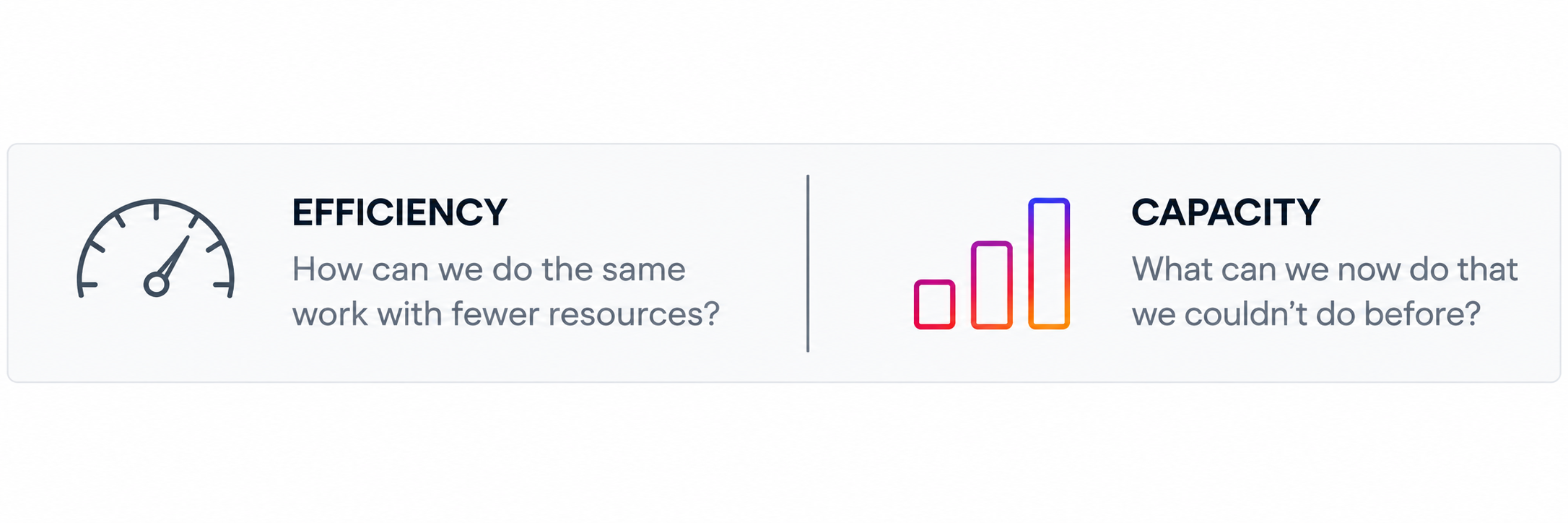
Efficiency and capacity aren't the same thing.
Efficiency asks, “How can we do the same work with fewer resources?”
Capacity asks, “What can we now do that we couldn't do effectively before?”
The opportunity isn't simply becoming more with less. It's becoming capable of doing more of what matters - giving people better information, enabling new services, or freeing talent for higher-value work.
Look for leverage not novelty.
A useful AI strategy doesn't require deploying AI everywhere. It requires identifying where additional capacity produces disproportionate value. Look across the organization for recurring constraints: Where does work slow down? Where are people spending time on work that doesn't require their judgment? Where could better information materially improve a decision?
Keep humans where humans matter.
Building capacity through AI means being intentional about where human capability creates the greatest value. Relationships. Judgment. Empathy. Leadership. Creativity. Context. Accountability. These remain fundamentally important. The strongest operating models will combine human and machine capabilities rather than treating one as a replacement for the other.
AI is part of an operating system.
Our Growth Operator model connects strategy, systems, technology, and execution. AI sits within that larger system. Strategy establishes what you're trying to accomplish. Systems determine how the work needs to happen. Technology multiplies capacity. Execution turns capabilities into outcomes.
A better question for leaders.
The next time the conversation turns to AI, resist starting with “What AI should we be using?” Start instead with: “Where would additional capacity make the greatest difference to what we're trying to accomplish?”
Because the organizations that benefit most from AI won't necessarily be those that adopt the most AI.
They'll be the ones that know where greater capacity matters.
“The organizations that benefit most from AI won't
necessarily be those that adopt the most AI. They'll be
the ones that know where greater capacity matters.”
BUILD WHAT THE OUTCOME REQUIRES
Ready to explore what's possible with AI in your organization?
Fourth Strategies helps organizations identify the where AI can create meaningful leverage - and then helps turn those opportunities into execution.

Elevate
Engage
Empower
Powered by Gropl